Digestive Health Institute
by Dr. Muffi

Digestive Health Institute
by Dr. Muffi
Femoral Hernia Symptoms
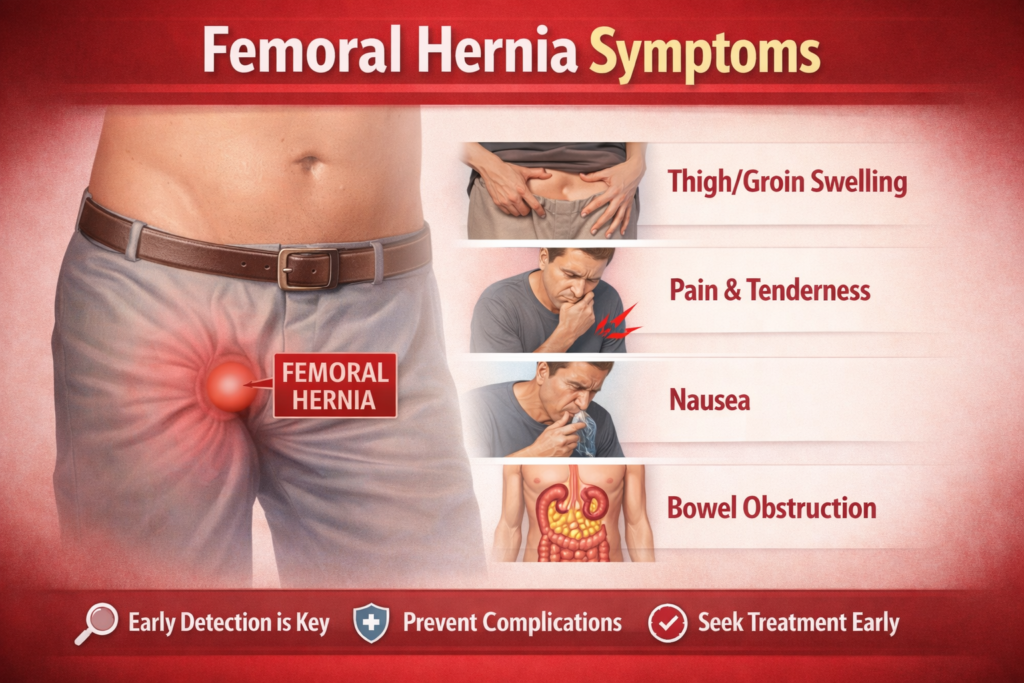
Many femoral hernias do not cause noticeable symptoms in the early stages, which is why they are often ignored until complications develop. However, recognizing early warning signs can help you seek timely treatment and avoid serious risks.
A femoral hernia is a less common but more dangerous type of hernia that appears near the groin and upper thigh and carries a higher risk of complications than other hernias.
What are the symptoms of femoral hernia?
- Small lump in the groin or upper thigh
- Pain or discomfort in the groin
- Pain spreading to the inner thigh
- Heaviness or burning sensation
- Pain that worsens with standing or lifting
- Sudden severe pain (emergency sign)
- Nausea or vomiting in serious cases
What Is a Femoral Hernia?
A femoral hernia occurs when abdominal tissue pushes through a weak spot in the femoral canal, located just below the groin crease near the upper thigh.
It is more common in women, especially due to:
- Pregnancy
- Increased abdominal pressure
- Natural pelvic structure
7 Common Femoral Hernia Symptoms
1. Small Lump Near the Groin or Upper Thigh
- A visible bulge just below the groin
- More noticeable when standing, coughing, or lifting
- May disappear when lying down
2. Groin Pain or Discomfort
- Dull aching or pressure in the groin
- Worsens with:
- Walking
- Straining
- Prolonged standing
3. Upper Thigh Pain
- Pain may radiate to the inner thigh
- Often mistaken for muscle strain or joint pain
4. Heaviness or Burning Sensation
- Feeling of fullness in the groin
- Mild burning or pulling sensation during movement
5. Pain That Gets Worse Over Time
- Symptoms may gradually increase
- Activities like lifting or bending can trigger pain
6. No Symptoms in Early Stages
- Some femoral hernias are silent initially
- Lump may not always be visible
7. Sudden Severe Pain (Emergency Sign)
- Indicates possible complication
- Requires immediate medical attention
Femoral Hernia Symptoms in Women
Femoral hernias are more common in women and may present differently:
- Vague pelvic discomfort
- Groin pain without a visible lump
- Pain during pregnancy or after childbirth
Because symptoms are subtle, diagnosis is often delayed.
When Is a Femoral Hernia Dangerous?
A femoral hernia can become life-threatening if it becomes strangulated (blood supply gets cut off).
Emergency symptoms include:
- Sudden severe pain
- A hard, tender lump
- Redness or swelling
- Nausea or vomiting
This is a medical emergency and requires immediate surgery.
What Causes a Femoral Hernia?
Common risk factors include:
- Heavy lifting
- Chronic constipation
- Obesity
- Pregnancy
- Persistent coughing
- Previous abdominal surgery
- Aging and muscle weakness
How Is Femoral Hernia Diagnosed?
Doctors may recommend:
- Physical examination
- Ultrasound
- CT scan (for unclear cases)
Imaging is often needed because femoral hernias are harder to detect.
Can Femoral Hernia Be Treated Without Surgery?
No. Femoral hernias do not heal on their own.
Non-surgical methods may:
- Temporarily relieve discomfort
- NOT prevent complications
Surgery is usually recommended due to the high risk of strangulation.
Does femoral hernia cause inner thigh or leg pain?
Yes, femoral hernia pain is often felt in the upper inner thigh and may sometimes spread down the leg.
- Pain is usually located just below the groin crease
- It may radiate to the inner thigh
- In some cases, discomfort can extend down the leg
- Pain worsens with walking, standing, or lifting
When Should You See a Doctor?
Consult a doctor if you notice:
- A lump in the groin or upper thigh
- Persistent groin pain
- Pain that worsens with movement
- Sudden increase in symptoms
Early treatment helps prevent serious complications.
Final Thoughts
Femoral hernia symptoms can be easy to miss but potentially dangerous. If you notice groin pain, a thigh lump, or unexplained discomfort, don’t ignore it.
Early diagnosis and treatment can prevent life-threatening complications.
FAQs: Femoral Hernia Symptoms
What are the early signs of a femoral hernia?
Early signs include a small lump in the groin or upper thigh, mild pain or discomfort, and a feeling of pressure that worsens with standing, coughing, or lifting. Some people may have no symptoms initially, making early detection difficult.
What does a femoral hernia feel like?
A femoral hernia typically feels like a soft bulge near the groin or upper thigh, along with a dull ache or heaviness. Pain may increase during movement, standing, or straining, and sometimes radiates to the inner thigh.
What are the dangers of a femoral hernia?
The main danger is strangulation, where the blood supply to the hernia is cut off. This can cause severe pain, a hard lump, nausea, vomiting, and requires emergency surgery if not treated promptly.
Can a femoral hernia heal itself?
No, a femoral hernia cannot heal on its own. Symptoms may seem mild at first, but the condition can worsen over time. Surgery is the only permanent treatment.
What is the best treatment for a femoral hernia?
The best treatment is surgical repair, which involves pushing the tissue back and strengthening the weak area. Surgery is recommended even for small hernias due to the high risk of complications.
What can be mistaken for a femoral hernia?
Conditions that may be mistaken include swollen lymph nodes, lipomas (fatty lumps), inguinal hernias, muscle strain, or vascular conditions. A proper medical evaluation is needed for accurate diagnosis.