Digestive Health Institute
by Dr. Muffi

Digestive Health Institute
by Dr. Muffi
4 Stages of Appendicitis: Symptoms, Risks & When You Need Surgery
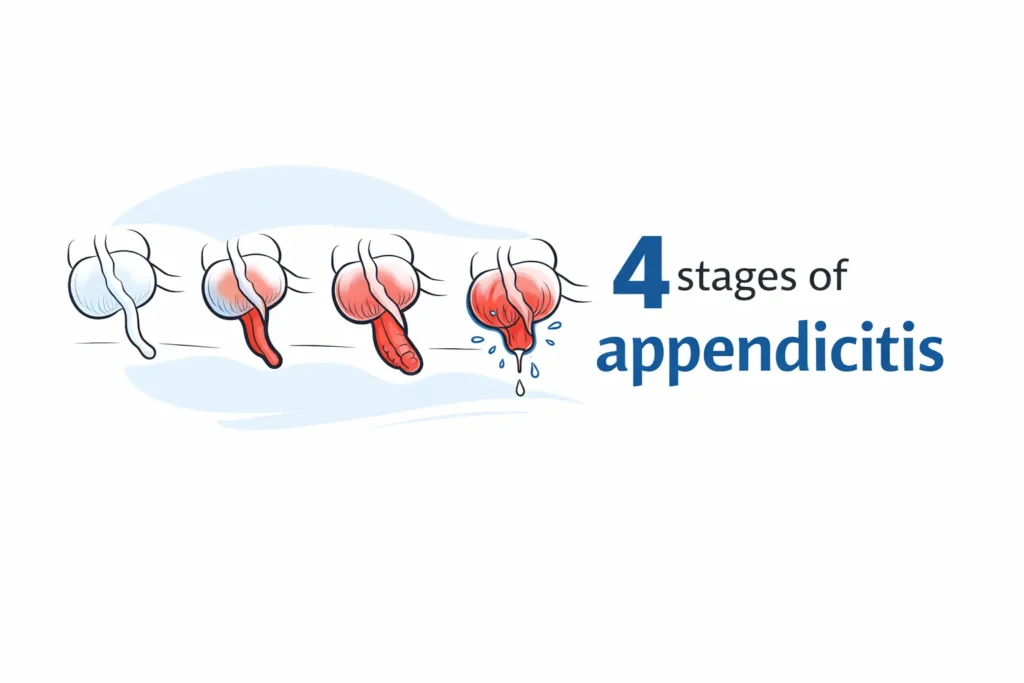
Appendicitis is one of the most common causes of emergency abdominal surgery worldwide. While many people think it appears suddenly, the condition actually progresses through 4 stages of appendicitis, each becoming more severe if left untreated.
Understanding the 4 stages of appendicitis is critical for early diagnosis, timely treatment, and preventing complications like rupture or infection spread. Recognizing symptoms early can significantly reduce the risk of life-threatening conditions.
In this detailed guide, we will break down the 4 stages of appendicitis, symptoms at each stage, causes, diagnosis, treatment options, and when you should seek immediate medical care.
What Is Appendicitis?
Appendicitis is the inflammation of the appendix, a small tube-like organ attached to the large intestine. It usually occurs when the appendix becomes blocked, leading to bacterial infection.g
Common Causes of Appendicitis
| Cause | Description |
|---|---|
| Fecal blockage | Hardened stool blocks the appendix |
| Infection | Viral or bacterial infections can trigger swelling |
| Enlarged lymph tissue | Common in younger patients |
| Tumors (rare) | Can obstruct the appendix |
Once blocked, the appendix becomes swollen, infected, and filled with pus, leading to the progression through the 4 stages of appendicitis. Many patients also wonder what food can cause appendicitis, but the condition is usually caused by blockage rather than diet alone.
Overview of the 4 Stages of Appendicitis
| Stage | Name | Severity | Risk Level |
|---|---|---|---|
| Stage 1 | Early (Simple) | Mild inflammation | Low |
| Stage 2 | Suppurative | Pus formation | Moderate |
| Stage 3 | Gangrenous | Tissue death | High |
| Stage 4 | Perforated | Rupture | Very High |
Each of these 4 stages of appendicitis has distinct symptoms and risks. Doctors also evaluate imaging reports to understand what size of appendix is dangerous and whether immediate surgery is required.
Stage 1: Early (Simple Appendicitis)
The first of the 4 stages of appendicitis is often mild and easily overlooked.
What Happens in This Stage
- The appendix becomes blocked
- Inflammation begins
- Pressure starts building inside
| Symptom | Description |
|---|---|
| Mild abdominal pain | Around the belly button |
| Loss of appetite | Early sign |
| Nausea | Mild discomfort |
| Low-grade fever | Slight temperature increase |
Stage 2: Suppurative Appendicitis
In the second stage of the 4 stages of appendicitis, infection becomes more severe.
What Happens
- Pus forms inside the appendix
- Infection spreads locally
- Pressure increases significantly
| Symptom | Description |
|---|---|
| Sharp abdominal pain | Moves to lower right abdomen |
| Fever | Moderate |
| Vomiting | Common |
| Tenderness | Severe pain on touch |
Clinical Significance
This is the stage where most patients seek medical attention. Surgery is usually required at this point.
Stage 3: Gangrenous Appendicitis
This is one of the most dangerous phases in the 4 stages of appendicitis.
What Happens
- Blood supply to the appendix is cut off
- Tissue starts dying (gangrene)
- Risk of rupture increases rapidly
| Symptom | Description |
|---|---|
| Severe continuous pain | Intense and persistent |
| High fever | Often above 101°F |
| Rapid heartbeat | Body under stress |
| Weakness | Fatigue and discomfort |
Why It’s Dangerous
At this stage, the appendix is close to bursting. Immediate medical intervention is critical.
Stage 4: Perforated Appendix (Rupture Stage)
The final and most severe of the 4 stages of appendicitis is rupture.
What Happens
- Appendix bursts
- Infection spreads into the abdomen
- Leads to peritonitis or sepsis
| Symptom | Description |
|---|---|
| Sudden pain relief | Temporary after rupture |
| Severe abdominal pain | Returns and worsens |
| High fever | Serious infection |
| Swollen abdomen | Due to infection spread |
| Complication | Description |
|---|---|
| Peritonitis | Infection of abdominal lining |
| Sepsis | Life-threatening infection |
| Abscess formation | Pus collection |
How Fast Do the 4 Stages of Appendicitis Progress?
The progression of the 4 stages of appendicitis can vary:
| Time Frame | Stage Progression |
|---|---|
| 24 hours | Early to suppurative |
| 48–72 hours | Gangrenous stage |
| 72+ hours | Rupture possible |
When Should You See a Doctor?
You should seek medical attention immediately if you notice:
| Warning Sign | Why It Matters |
|---|---|
| Persistent abdominal pain | Key symptom |
| Pain shifting to right side | Classic appendicitis sign |
| Fever with vomiting | Infection indicator |
| Difficulty moving | Pain worsens |
Diagnosis of Appendicitis
Doctors use multiple methods to identify which of the 4 stages of appendicitis you are in.
| Test | Purpose |
|---|---|
| Physical exam | Check tenderness |
| Blood test | Detect infection |
| Ultrasound | Visual confirmation |
| CT scan | Most accurate imaging |
Treatment Options for Appendicitis
Treatment depends on which of the 4 stages of appendicitis the patient is experiencing.
1. Laparoscopic Appendectomy
Laparoscopic appendectomy is the most common and effective appendicitis surgery in Mumbai for treating all stages safely.Laparoscopic appendectomy is the most common and effective appendicitis surgery in Mumbai for treating all stages safely.
Minimally invasive surgery
Small incisions
Faster recovery
Preferred for early stages of the 4 stages of appendicitis
2. Open Surgery
Required in complicated or ruptured cases
Longer recovery
3. Antibiotic Therapy (Limited Cases)
Used in very early stages
Not always a permanent solution
Recovery After Appendicitis Surgery
| Stage | Recovery Time |
|---|---|
| Early | 1–2 weeks |
| Suppurative | 2–3 weeks |
| Gangrenous | 3–4 weeks |
| Perforated | 4+ weeks |
FAQs About the 4 Stages of Appendicitis
- What can be mistaken for appendicitis?
Conditions like stomach infections, kidney stones, UTIs, ovarian cysts, and digestive issues can cause similar abdominal pain. - What foods can irritate the appendix?
No specific foods directly irritate the appendix, but a low-fiber diet and processed foods may increase risk. - Can you live normally after appendix removal?
Yes, people live a normal, healthy life after appendix removal with no major long-term effects. - What age is most common for appendicitis?
Appendicitis is most common between ages 10 and 30. - What are five signs of appendicitis?
Lower right abdominal pain, nausea, vomiting, loss of appetite, and mild fever. - Can you have appendicitis without a fever?
Yes, especially in early stages, appendicitis can occur without a fever.