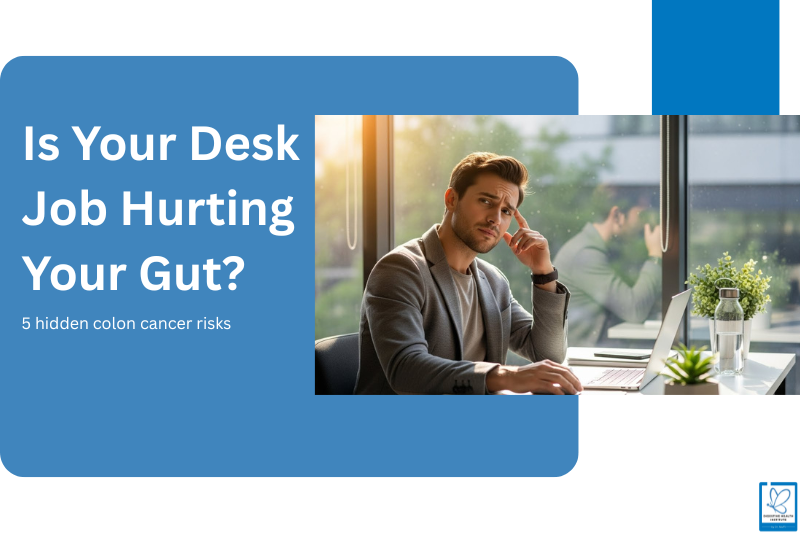
Most of us spend at least eight hours a day tethered to a chair. We worry about our backs and our posture, but we rarely consider what all that sitting is doing to our internal health.
While doctors always tell us to “eat more fiber,” there are several other hidden factors—from your office habits to your bedtime routine—that play a massive role in your colorectal cancer risk. If you want to protect your gut, it’s time to look beyond the salad bowl.
Here are 5 surprising, science-backed ways to lower your risk that have nothing to do with your fiber intake.

We often associate Vitamin D with bone health or “the sunshine vitamin,” but research suggests it plays a massive role in colon health. Low levels of Vitamin D have been linked to an increased risk of colorectal tumors.
The Surprise: It’s not just about being outside; many of us are chronically deficient due to indoor lifestyles.
Action Step: Ask your doctor for a simple blood test to check your levels. You might need a supplement, especially during winter months.
It sounds strange—how does sleep affect your colon? It comes down to melatonin. Melatonin is a powerful antioxidant that helps regulate cell regeneration. Chronic sleep deprivation or working night shifts can disrupt your circadian rhythm, which has been linked to higher rates of digestive cancers.
The Surprise: A dark room and 7–8 hours of shut-eye act as a nightly “repair shop” for your DNA.
Your spice rack might be your best defense. Curcumin, the active compound in turmeric, has been studied extensively for its ability to reduce inflammation in the digestive tract and potentially shrink precancerous polyps.
The Surprise: Curcumin is hard for the body to absorb on its own. Pairing it with black pepper increases its absorption by up to 2,000%.

You might hit the gym for 30 minutes, but if you sit for the other 23 hours of the day, your risk remains elevated. “Sedentary behavior” is now considered a distinct risk factor from a lack of exercise. Sitting causes blood sugar and insulin levels to spike, which can encourage the growth of polyps.
The Surprise: Short “activity snacks”—standing up and stretching for 2 minutes every hour—can significantly improve your metabolic health.
This is perhaps the most shocking connection: the bacteria in your mouth can travel to your gut. Studies have found that Fusobacterium nucleatum, a bacterium common in gum disease—is often present in colorectal tumors and may help them grow.
The Surprise: Flossing isn’t just for your smile; it might actually be protecting your colon by keeping harmful bacteria out of your system.
Prevention is a mosaic of small habits. While no single food or habit is a “magic bullet,” combining these surprising strategies with regular screenings (like colonoscopies) gives you the best possible defense.
Note: Always consult with a healthcare professional before starting new supplements or making significant lifestyle changes
1.Can sitting too long really increase cancer risk?
Yes. Research shows that prolonged sedentary behavior can lead to higher inflammation and insulin resistance, both of which are linked to an increased risk of colorectal cancer. It is recommended to stand or move for at least 2 minutes every hour.
2. How does oral health affect my colon?
Certain harmful bacteria that cause gum disease, such as Fusobacterium nucleatum, can travel through the bloodstream or digestive tract to the colon. Once there, they can promote inflammation and the growth of cancerous cells.
3. Does Vitamin D really help prevent polyps?
Higher levels of Vitamin D are strongly associated with a lower risk of developing colorectal polyps and tumors. Vitamin D helps regulate cell growth and prevents the “bad” cells from multiplying.
4. Is colorectal cancer preventable?
Up to 90% of colorectal cancer cases are preventable or highly treatable if caught early through regular screenings (like colonoscopies) and healthy lifestyle choices.
5. What is the most important “hidden” risk factor?
While all factors matter, regular screening is the most critical. Many “hidden” risks like small polyps show no symptoms, which is why early detection is the best defense regardless of your diet or activity level.