
Digestive Health Institute
by Dr. Muffi

Digestive Health Institute
by Dr. Muffi
Can Hernia Be Treated Without Surgery?
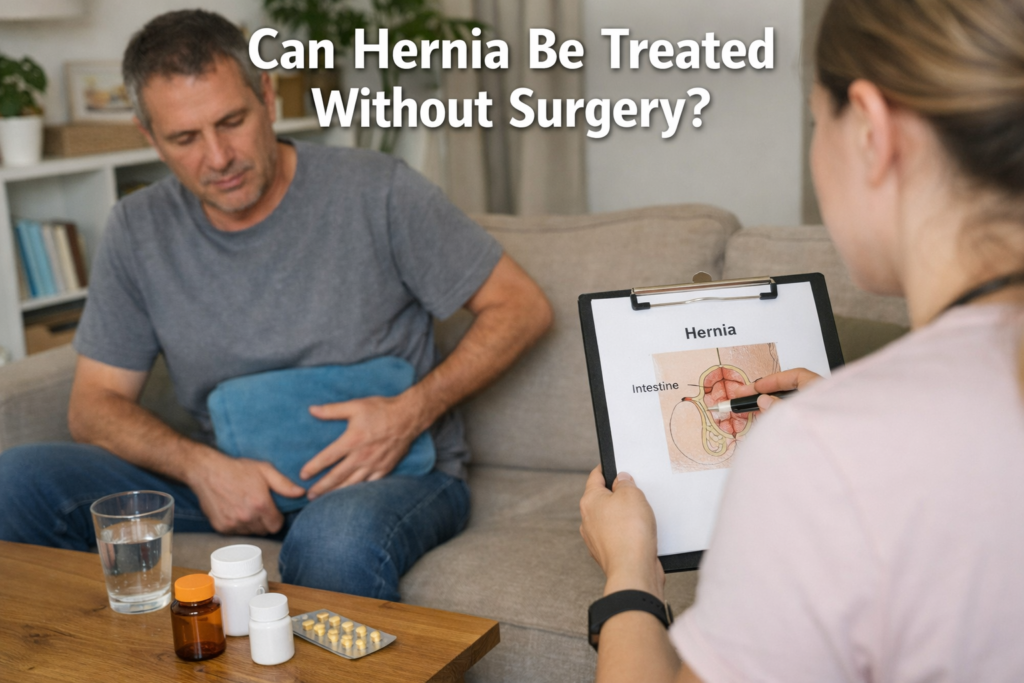
Can Hernia Be Treated Without Surgery? Honest Answers Patients Need
After being diagnosed with a hernia, many people ask:
“Can a hernia be treated without surgery?”
It’s a very common and very reasonable question, especially if you’re worried about pain, recovery, or cost.
The honest answer is:
– A hernia cannot be permanently cured without surgery, but in some cases, symptoms can be managed temporarily.
Let’s explain this clearly.
Why a Hernia Usually Needs Surgery
A hernia happens when an internal organ pushes through a weak area in the muscle wall.
Once this weakness develops:
- It does not heal on its own
- The opening in the muscle does not close naturally
- Over time, the hernia often becomes larger
Surgery is the only treatment that repairs the muscle defect.
When Is Surgery NOT Immediately Required?
In certain situations, doctors may recommend watchful waiting, especially if:
- The hernia is small
- There is little or no pain
- The hernia is easily reducible
- Daily activities are not affected
This approach means:
- Regular monitoring
- Lifestyle adjustments
- Understanding that surgery may still be needed later
Non-Surgical Ways to Manage Hernia Symptoms
While these do not cure a hernia, they may reduce discomfort:
Lifestyle Changes
- Avoid heavy lifting
- Maintain a healthy weight
- Prevent constipation and straining
- Quit smoking to reduce coughing
Supportive Measures
- Hernia belts or trusses (temporary support only)
- Proper posture during movement
These methods do not fix the hernia and should not replace medical advice.
Risks of Avoiding Hernia Surgery
Delaying surgery for too long can lead to complications such as:
- Increasing pain
- Larger hernia size
- Bowel obstruction
- Strangulation (cutting off blood supply), which is a medical emergency
Emergency hernia surgery carries higher risk than planned surgery.
Can Hernia Heal on Its Own?
No.
Once a hernia develops, it does not go away without surgery.
What may happen instead:
- Symptoms may temporarily reduce
- The bulge may come and go
- The underlying weakness remains
When Is Surgery Strongly Recommended?
Doctors usually advise surgery when:
- Pain increases
- The hernia grows larger
- Daily life is affected
- There is risk of complications
Early planned surgery often means:
- Easier procedure
- Faster recovery
Better long-term results
Final Answer: Can Hernia Be Treated Without Surgery?
Hernia symptoms can sometimes be managed without surgery, but the condition itself cannot be permanently treated without surgical repair.
If a hernia is causing discomfort or limiting your life, surgery is the most effective and safest long-term solution.
When to Seek Immediate Medical Help
Get urgent care if you experience:
- Sudden severe pain
- Redness or tenderness over the hernia
- Vomiting
- Fever
These may indicate complications.
FAQs: Can Hernia Be Treated Without Surgery?
Is hernia curable without operation?
No. A hernia cannot be permanently cured without surgery.
While symptoms may be managed for a short time, the muscle weakness that causes a hernia does not heal on its own.
Non-surgical options like lifestyle changes or hernia belts may reduce discomfort, but they do not fix the hernia. Surgery is the only treatment that repairs the defect and offers a long-term solution.
Is it okay to live with a hernia?
In some cases, yes for a short time.
If the hernia is small and painless, doctors may suggest watchful waiting with regular monitoring.
However, living with a hernia long-term is not recommended because:
- Hernias usually get larger over time
- Pain and discomfort may increase
- The risk of complications can rise
Most doctors advise planned surgery once symptoms appear.
How long can I stay with a hernia?
There is no fixed time limit, but a hernia should not be ignored.
Some people live with a hernia for months or years without major issues, while others develop problems quickly. Because it’s impossible to predict progression, regular medical follow-up is important if surgery is delayed.
Early treatment often means simpler surgery and faster recovery.
What happens if I delay hernia surgery?
Delaying hernia surgery can lead to:
- Increasing pain and discomfort
- Enlargement of the hernia
- Difficulty performing daily activities
- Higher chance of emergency surgery
In rare cases, delaying treatment may cause strangulation, where blood supply to the trapped organ is cut off. This is a medical emergency.
Planned surgery is much safer than emergency surgery.
What is the best treatment for a hernia?
The best and most effective treatment for a hernia is surgery.
Modern hernia repair:
- Is safe and commonly performed
- Often uses minimally invasive (laparoscopic) techniques
- Has a high success rate
- Provides long-term relief
Your surgeon will recommend the best approach based on the type and size of the hernia and your overall health.