

Advanced, Evidence-Based Weight Loss Care with Dr. Muffazal Lakdawala
Obesity is not a failure of willpower. It is a chronic medical condition that affects metabolism, hormones, and long-term health. When diet, exercise, and medications do not provide sustainable results, Bariatric Surgery in Mumbai can offer a scientifically proven path toward lasting weight loss and improvement in obesity-related conditions.
If you are considering weight loss surgery, you likely have important questions:
Is it safe?
Will I regain weight?
What is recovery like?
How do I know if I qualify?
Dr. Muffazal Lakdawala is a globally recognized bariatric and robotic surgeon practicing in Mumbai, with decades of experience in advanced laparoscopic and robotic procedures. His approach combines medical precision with compassionate, patient-centered care.
For additional expert perspectives on evidence-based obesity treatment and long-term metabolic care, you can explore India Today – Obesity management insights, published by India Today, which highlights the growing need for medically supervised weight management and advanced bariatric solutions.
Bariatric surgery refers to surgical procedures that:
Reduce the size of the stomach
Alter gut hormones that regulate hunger
Improve metabolism
Help control diabetes and other metabolic diseases
Modern bariatric surgery is performed laparoscopically or robotically through small incisions, allowing faster recovery and reduced pain compared to traditional open surgery.
Eligibility is typically based on international medical guidelines.
You may qualify if:
BMI ≥ 40 (with or without medical conditions)
BMI ≥ 35 with obesity-related diseases such as diabetes, hypertension, sleep apnea
BMI 30–34.9 with uncontrolled type 2 diabetes or metabolic syndrome (in selected cases)
Different procedures are suited for different patients. The choice depends on BMI, health conditions, eating patterns, and long-term goals.
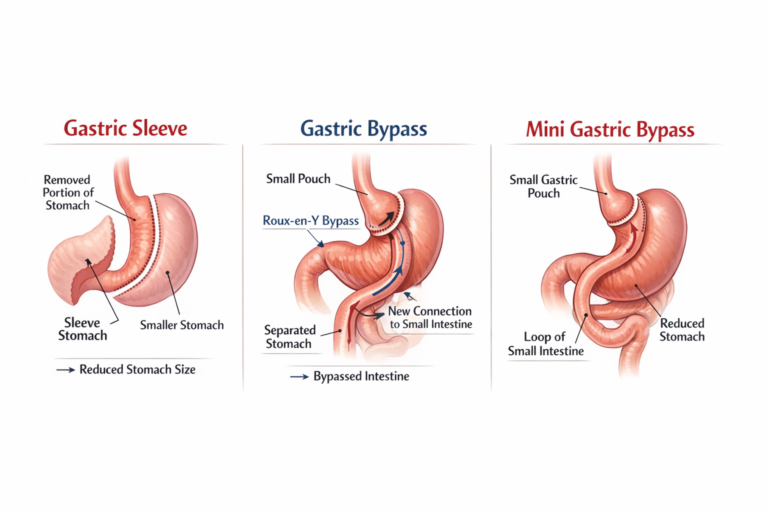
The gastric sleeve involves removing approximately 75–80% of the stomach, leaving a narrow tube-like structure.
How it works:
Restricts food intake
Reduces hunger hormone (ghrelin)
Improves insulin sensitivity
Benefits:
Significant weight loss
Effective diabetes control
No intestinal bypass
Shorter operative time
This is one of the most commonly performed bariatric procedures worldwide.
This procedure creates a small stomach pouch and reroutes a portion of the small intestine.
How it works:
Restricts food intake
Alters nutrient absorption
Produces powerful metabolic effects
Best suited for:
Severe obesity
Long-standing diabetes
Acid reflux patients
It has strong evidence for long-term diabetes remission and durable weight loss.
This simplified variation of gastric bypass uses a single connection (anastomosis).
Advantages:
Shorter operative time
Effective weight loss
Strong metabolic improvement
It may be recommended in selected patients based on medical history and BMI.
Some patients experience:
Inadequate weight loss
Weight regain
Severe reflux
Surgical complications from previous procedures
Revision surgery corrects or modifies earlier bariatric procedures. These operations are technically complex and require advanced expertise.
The broader conversation around obesity care is also evolving at a national level. In Business Today – Modern obesity treatment discussion, featured by Business Today, Dr. Muffazal Lakdawala explains how obesity management today goes beyond crash diets and temporary solutions, focusing instead on structured medical therapy, advanced metabolic surgery, and long-term lifestyle transformation for sustainable results.
Dr. Lakdawala is known for his expertise in robotic-assisted bariatric surgery.
Robotic technology provides:
Enhanced 3D visualization
Greater precision
Improved dexterity
Better ergonomics for complex cases
For patients, this may translate to:
Less postoperative discomfort
Reduced blood loss
Faster recovery in selected cases
Robotic surgery is particularly valuable in revision cases and high-BMI patient
Safety is one of the most common concerns.
Modern bariatric surgery has safety outcomes comparable to common procedures like gallbladder surgery.
Risk Considerations
Possible complications include:
However:
No surgery is 100% risk-free, but when performed by experienced specialists in accredited hospitals, bariatric surgery is considered safe and effective.
Weight loss varies depending on procedure and patient compliance.
Average Outcomes
Beyond weight reduction, patients often experience:
Long-term success depends on:
Surgery is a tool , not a shortcut but it can reset metabolism in powerful ways.
Understanding recovery helps reduce anxiety.
Hospital Stay
First Week
Weeks 2–4
4–6 Weeks
3–6 Months
Nutritional supplementation and follow-up visits are essential.
Rapid weight loss without medical supervision can sometimes cause more harm than good. In Financial Express – Risks of crash dieting, published by The Financial Express, Dr. Muffazal Lakdawala discusses how extreme dieting can negatively impact metabolism, hormonal balance, and long-term health, reinforcing the importance of structured, medically guided obesity treatment.
Dr. Muffazal Lakdawala is a leading bariatric and robotic surgeon in Mumbai with international recognition for his work in advanced minimally invasive surgery.
He is affiliated with Sir H. N. Reliance Foundation Hospital & Research Centre, one of Mumbai’s premier tertiary-care hospitals known for advanced surgical infrastructure and patient safety standards.
His approach emphasizes:
Patients from across India and abroad seek consultation for advanced bariatric and metabolic procedures.
“What if I regain weight?”
Weight regain can occur if lifestyle guidelines are not followed. Structured follow-up programs significantly reduce this risk.
“Will I need surgery again?”
Most patients do not. However, revision surgery may be required in selected cases.
“Will I have loose skin?”
Significant weight loss may result in loose skin. This can be addressed later through body contouring procedures if desired.
“Is it painful?”
Most procedures are minimally invasive. Pain is manageable with medication, and early walking is encouraged.
Bariatric surgery can lead to:
These metabolic improvements are supported by extensive global research.
India is facing a rapidly growing obesity burden, affecting both urban and semi-urban populations. In BBC News – India’s rising obesity challenge, reported by BBC News, the discussion highlights how lifestyle shifts, changing food patterns, and reduced physical activity are contributing to a national metabolic health crisis. The feature underscores the importance of early intervention, structured medical management, and when appropriate, bariatric surgery as part of comprehensive obesity care.
2022, Miami
2019, Las Vegas
2019, Barcelona
2017, India
Book your consultation to receive a personalized evaluation and begin your journey with expert, evidence-based care in Mumbai.